Series: Building Backarch, engineering decisions from building backarch.com
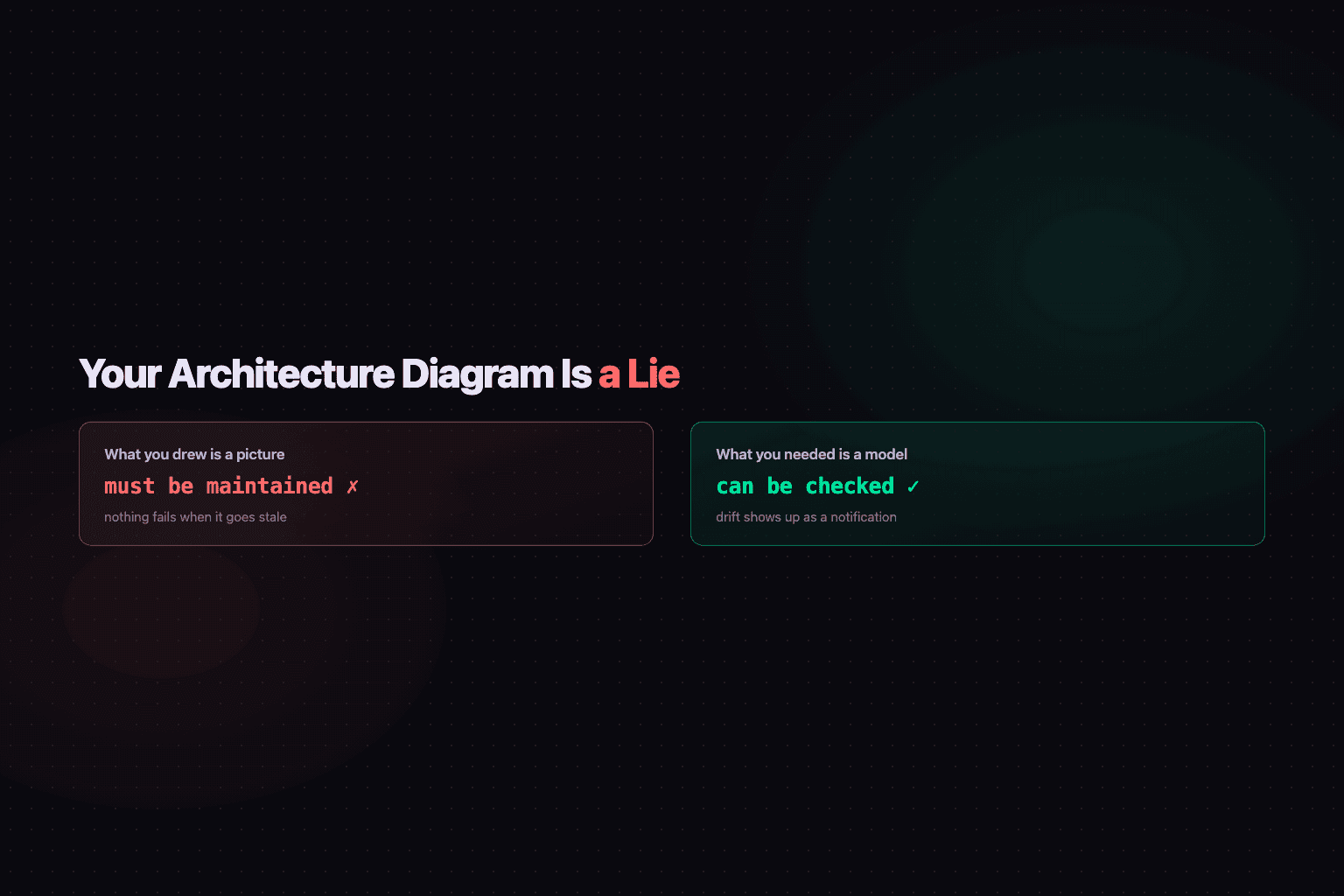
Your architecture diagram is a lie.
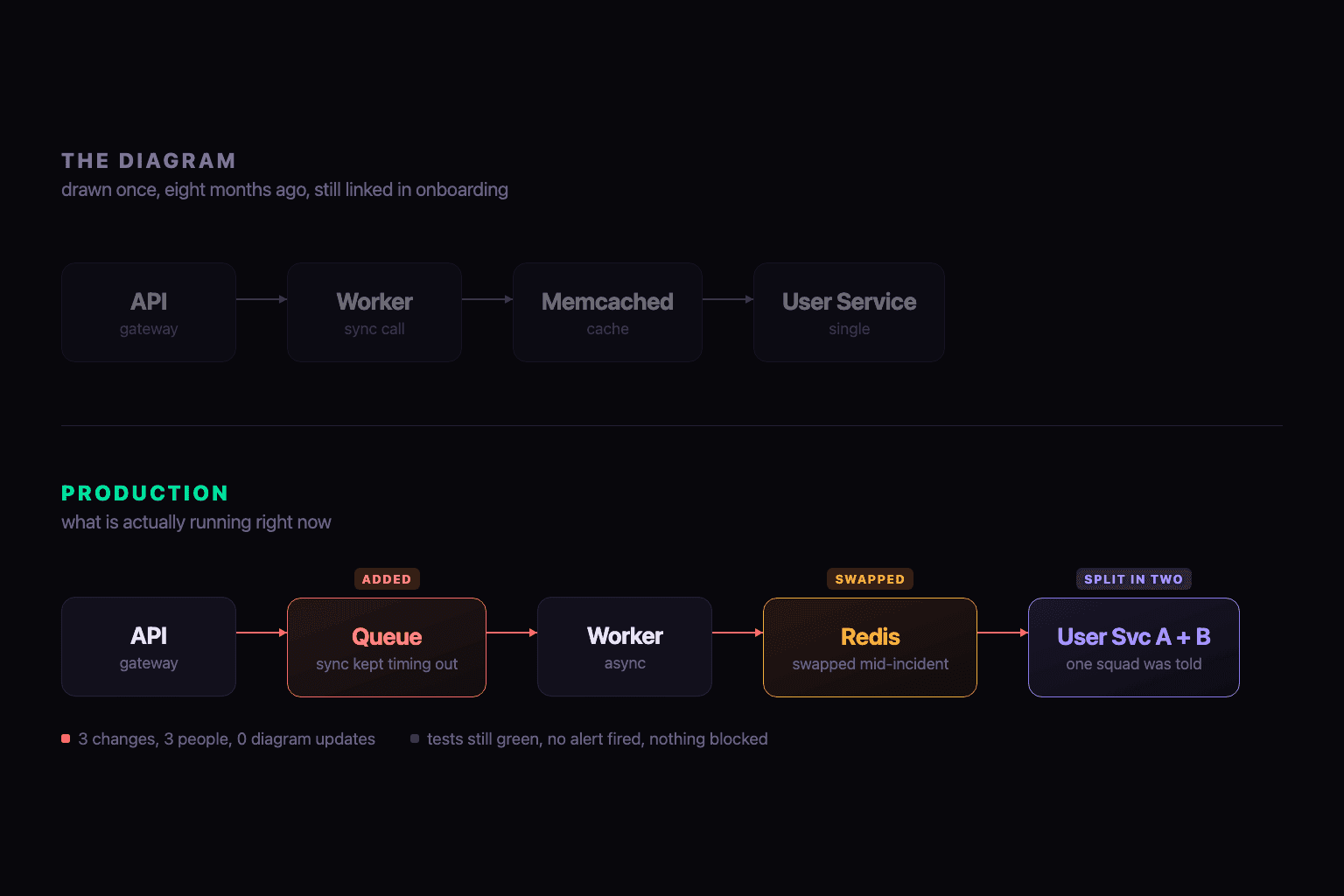
Not deliberately. It was accurate the day you drew it. Then someone added a queue between the API and the worker, because the synchronous call kept timing out under load. Someone else swapped the cache from Memcached to Redis in the middle of an incident and never went back to write it up. A third person split the user service in two and told their squad, which felt like telling everyone.
None of them updated the diagram.
The easy read is that engineers are careless about documentation. That read is wrong, and it sends teams looking for a fix in the wrong place: more process, a documentation champion, a checklist item in the PR template. None of it works for long, because the problem is not discipline.
The problem is that updating the diagram doesn't do anything.
The diagram has no consequences
Think about what happens when your architecture diagram is wrong.
Nothing. No test fails. No alert fires. No deploy is blocked. No reviewer is forced to look at it. The build stays green. The system keeps serving traffic. The diagram sits in Confluence, slowly decaying into fiction, and the only signal that anything is wrong arrives months later, in a form nobody connects back to the diagram.
Now think about what happens when your database migration is wrong. Or your type definitions. Or your Terraform state. Something breaks immediately, loudly, in front of someone who has to fix it before they can continue.
That difference is the whole story. Engineers maintain the artifacts that are load-bearing, and they do it reliably, without a process pushing them. Nobody writes a quarterly reminder to keep function signatures in sync with their call sites. The compiler is the reminder. Nobody schedules a working session to reconcile the schema with the ORM models. The migration fails, and someone fixes it in the next ten minutes.
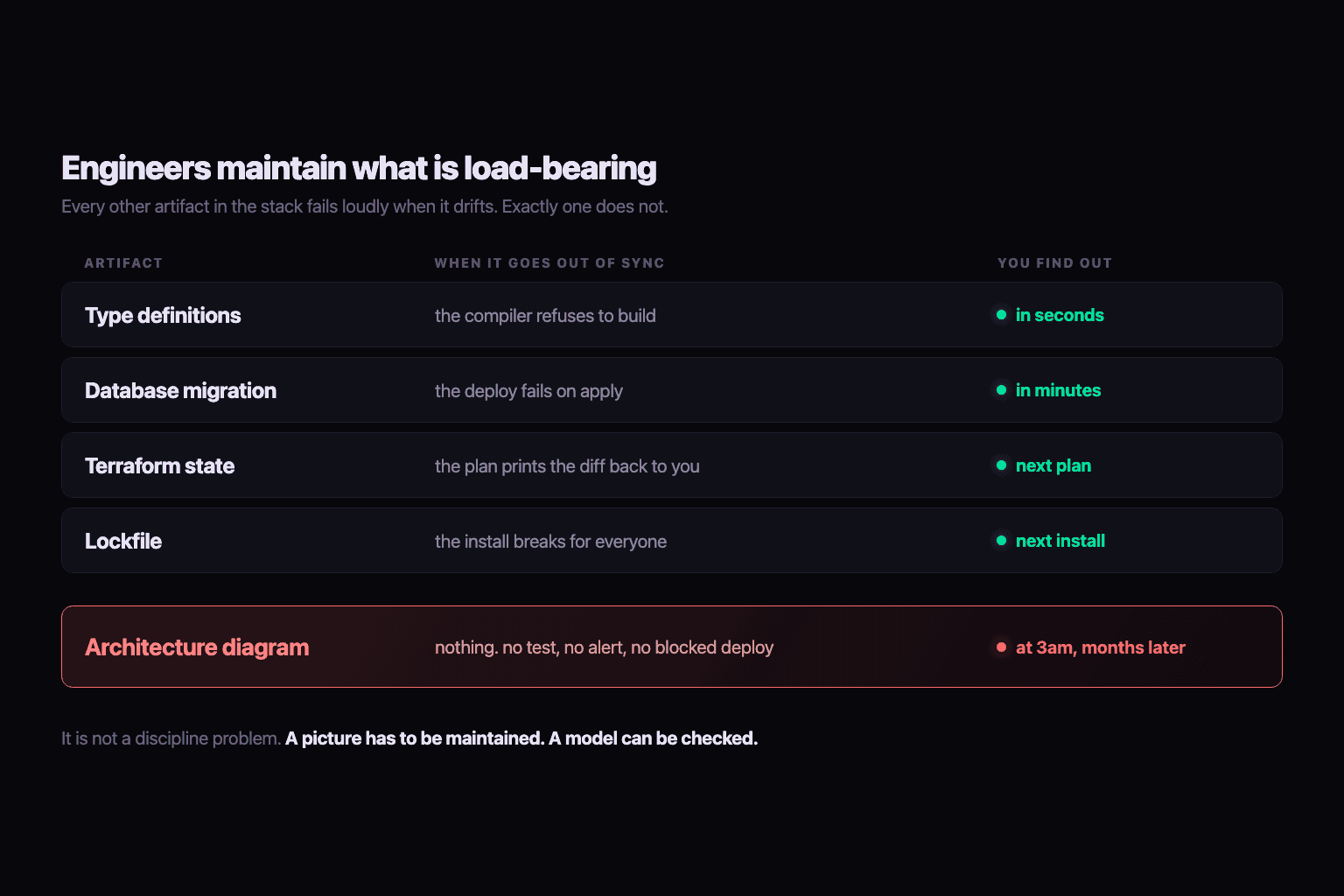
Architecture diagrams are the only artifact in the stack that describe the system without being connected to it. They are downstream of everything and upstream of nothing. So they rot, and the rot is invisible until it isn't.
The cost is real, it just arrives late
The reason this failure survives is that the cost is deferred and unattributed. It lands on someone other than the person who could have prevented it, weeks or months after the moment of divergence.
Usually it lands on a new engineer in their second week, confidently building against a component that was removed eight months ago. They lose two days. Nobody records those two days as a documentation cost. They get recorded as ramp-up time, which is understood to be slow, which is understood to be normal.
Or it lands on you at 3am, holding a pager, opening the diagram during an incident. This is the worst version, because it is exactly the moment the diagram is supposed to earn its existence. Instead you spend the first fifteen minutes of a live incident establishing which parts of the picture you can still trust. Often the honest answer is that you can't trust any of it, so you close it and go read the code and the dashboards instead.
Nothing is honest. A stale diagram is confidently misleading, and it misleads hardest during an incident, which is precisely when it was supposed to be worth having.
Everybody already knows this
Here is the part that should bother us more than it does: this is not a discovery. Every engineer already knows their architecture diagrams are stale. I have never met one who believed otherwise.
It is a universally acknowledged, universally tolerated failure. We have collectively agreed to keep producing an artifact we all privately assume is wrong, and to keep referencing it in onboarding docs and design reviews anyway.
We tolerate it because the alternative looks impossible. Manually keeping a picture in sync with a system that changes several times a day was never realistically going to happen, so we stopped expecting it to. The expectation quietly dropped, the practice stayed.
But "humans won't manually sync a picture with a fast-moving system" is a true constraint that we drew the wrong conclusion from. The right conclusion isn't that architecture documentation is hopeless. It's that the picture was the wrong output all along.
A picture has to be maintained. A model can be checked.
The distinction that matters is not visual fidelity or tooling polish. It is whether the thing you produced is a drawing or a data structure.
A drawing is a set of shapes and labels that a human arranged to mean something. Its correspondence to reality lives entirely in the head of whoever drew it. Nothing can validate it, because to a machine it is decorative. The only way it stays true is if a person keeps choosing to make it true, forever, with no feedback when they don't.
A model is a description of components and their relationships that something else can read. Once your architecture exists as data, questions become answerable mechanically:
- Does every service in this model exist in the cluster?
- Does every dependency drawn here appear in real traffic?
- Is anything running in production that appears nowhere in the model?
None of those questions can be asked of a PNG. All of them can be asked of a graph, and asked continuously, by a job that runs whether or not anyone remembers to care that week.
This is the same move the industry already made everywhere else. We stopped hand-maintaining server inventories and described infrastructure as code that gets applied and diffed. We stopped maintaining separate API documentation and generated it from a spec that the server itself is validated against. We stopped tracking dependency versions in a wiki page and let a lockfile be the truth. In each case the fix was not better discipline. It was making the description executable, so divergence became detectable.
Architecture diagrams are the last significant artifact still stuck on the wrong side of that line.
What changes when drift is detectable
The interesting shift isn't that the picture becomes accurate. It's that "accurate" stops being something you hope for and becomes something you measure.
Drift stops being a discovery and becomes an event. Instead of finding out during an incident that the diagram bears no resemblance to production, you get told on a Tuesday afternoon that a service was added last week that nothing in your model accounts for. That is a small, cheap, boring notification, which is exactly what it should be. Every expensive failure mode described earlier is the same information arriving late.
It also changes what a diagram is for. Today, architecture diagrams are mostly used to explain a system to humans, which is why they get made once, for a specific audience, at a specific moment, and then abandoned. A checkable model gets used by tooling continuously, which means it has a reason to stay correct that doesn't depend on anyone's good intentions.
The version of this that works is not a better drawing tool. It's a diagram that knows what your infrastructure actually looks like, so that drift is something the system reports rather than something a person eventually stumbles into.
Until then, everyone keeps drawing pictures that were true once, and quietly agreeing not to rely on them.
This is the problem Backarch is being built around: treating an architecture diagram as a model that can be checked against what is actually running, rather than a picture somebody has to remember to redraw.
The question worth asking: what's the oldest diagram your team still links to in onboarding, and when did anyone last confirm it was true?